
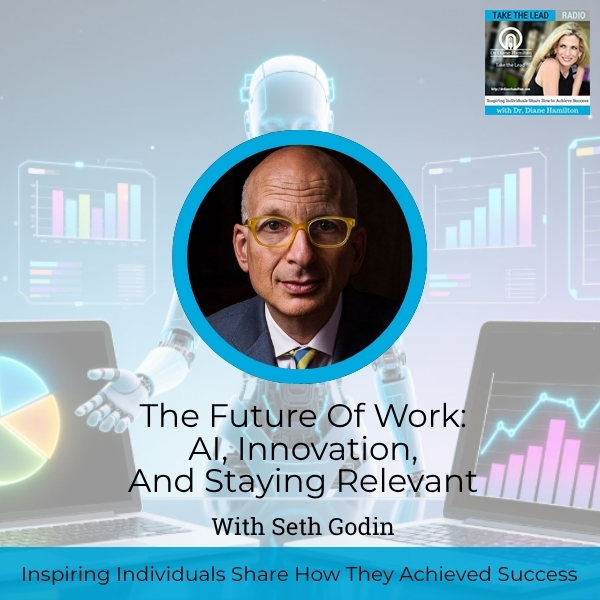
What if the biggest shift in your career is happening right now—and you’re not prepared? In this riveting conversation, marketing legend and best-selling author Seth Godin joins Dr. Diane Hamilton to unpack the seismic changes reshaping the future of work. From the disruptive force of AI—“the biggest change since electricity,” as Godin puts it—to the urgent need for real upskilling, this discussion is essential for anyone navigating modern business. Godin challenges the way marketing is taught, explains why Google’s miracle business model is under threat, and offers powerful insights on overcoming the fear that cripples both creativity and curiosity. Discover why embracing innovation at the smallest level is your best defense against becoming obsolete in the age of algorithms.

I am here with Seth Godin, who is the author of 21 bestsellers. He’s a member of the Marketing Hall of Fame, the founding editor of The Carbon Almanac, a blogger, an entrepreneur, and one of the world’s most sought-after speakers. It’s so nice to have you here, Seth.
Listen to the podcast here
The Future Of Work: AI, Innovation, And Staying Relevant With Seth Godin
Thanks, Diane. It’s good to see you.
I was looking forward to this. I was working on something. I teach a lot of marketing classes, so this is fun for that. I also had seen that you were going to be speaking at the World Business Forum in New York. I was very curious to know what your topic is because I’ve seen you change things up quite a bit. What is your focus for the year?
The Urgency Of Innovation In the Era Of AI and Descaling
It’s worth talking about innovation because we don’t understand it. In the era of AI, it’s urgent that we do so. AI is the biggest change in our world since electricity. It is the last step in the capitalist desire to de-skill employees. What is de-skilling? De-skilling is what Karl Marx talked about and Adam Smith as well, which says if you’re going to build any institution, you don’t want to rely on highly skilled people because highly skilled people get paid a lot. If they leave, it’s very disruptive. What you want is to take the skill from the highly skilled people and put it into the machine or put it into the system.
AI is the biggest change in our world since electricity.
The number of talented cobblers who work at Nike is very low because Nike has built an entire system and machinery so that they can train someone to work on the sneaker assembly line in five minutes. This is repeated industry after industry. You don’t have to be a brilliant agronomist to be a farmer anymore. It’s all a system. What AI is doing is coming for the people who pride themselves on having skill, for writers, for designers, for inventors, and for artists. An app like Sora says, “Type four words. I’ll make you a short movie.”
That doesn’t mean you’re Darren Aronofsky. It means you typed in four words. What’s the alternative? The alternative is upskilling. The alternative is instead of using AI to do our job, to do our projects, we give it every small task we can think of. We elevate our role to be the innovator, the project manager, and the person with the vision. I wrote a book called The Practice years ago. I care a lot about innovation and creativity. We all have a chance to show up and produce it.
You bring up so many interesting points.
That was a rant. Sorry about that.
Not at all. You don’t know rants. Don’t get me going. As a curiosity expert, since that’s what I write about, I’m fascinated by the answers that people have to what’s going on with AI right now. I used to sell computers in the ’80s when everybody was freaking out that their jobs were going to be lost. It was a tough time because people didn’t know. You didn’t know there would be social media managers because you didn’t know there’d be social media. It’s a lot different at this time because of the number of jobs that AI can replace and the level.
It’s very hard for people to see the next thing because sometimes, it changes by the day. I was watching one of your interviews before this. You mentioned Claude. I use ChatGPT. There are so many out there that you could use. You already mentioned you got an upskill, but there are some people who think that that’s for the smarter people or the different people than they are. They think, “I don’t want to be at this high level. I like being what I’m doing.” What do you tell people who are afraid of that?
Using the word fear is super important. If you want to run the New York City Marathon and you hire a coach, you can’t go to the coach and say, “Teach me to run the marathon without getting tired.” It can’t be done. The difference between people who finish and people who quit at mile 24 is that the people who finish figure out where to put the tire. That’s what you want your coach to do. It is to help you figure out where to put the tire.
The difference between people who finish and people who quit is this: the people who finish figure out where to put the tired.
If you have been indoctrinated or lulled yourself into a sense of satisfaction by doing tasks that other people assign you all day, it’s great. It’s good to be satisfied. I hate to tell you, but that’s going away. If you are afraid, that’s fine. It’s natural to be afraid because we’re about to pull the rug out from under 20, 30, or 40 years of promises that have been made to you. The promises were, “Show up, do the checklist, do what you’re told, and we’ll take care of you.”
If you do that at Waffle House, Avis Rent-a-Car, or Morgan Stanley, there’s someone you work for who is working as fast as they can to get rid of your job. That’s not going to be happy when it occurs unless you say, “Great news. I found a way to get this job done without me having to check boxes because I can do better than check boxes. Let me be the person who draws boxes instead.” I get that’s not what you signed up for, but that’s what’s here.
A lot of people have a hard time with change. You mentioned fear. I created an assessment that determines the factors that impact curiosity. Fear was one. Assumptions were another, the voice in our head. There is technology, the over- and under-utilization of it, and the environment, people with whom we’ve interacted. You talk about a lot of these things. What was interesting to me in my research, I expected fear to overwhelm all the other ones, but they were all equal.
It’s every day, though, things are changing. I don’t know how much you’ve looked into the Atlas version of ChatGPT because it’s only on Mac right at this moment. That’s going to be pretty much looking like a Google or one of those. You’re very familiar with Yahoo. You see what happens. What do you think is going to happen when Chat can do everything Google can do? Will they still advertise what’s going to happen to Google?
Google’s Unique Business Model & The Threat of Generative AI
Google put my company out of business years ago, so I’m not going to shed any tears if Google goes away. Leaving that aside, Google stumbled into a miracle. It was a miracle that had never happened before and will probably never happen again. That miracle was a perfect match between advertising and users. During its glory fifteen-year run, the users wanted there to be ads. In the same way, if you opened the classifieds of the newspaper in Phoenix and there were no classifieds, you were disappointed. You wanted there to be classifieds.
Google built a giant auction engine for classifieds. A way to understand this is if you’re a class action lawsuit lawyer and a new client for some horrible disease is worth $1,000 to you, you’re bidding for clicks to get people to your site. You’re willing to bid up until you’ve reached the amount where you break even, because even if you make $10 on that client, you’re still willing to bid. There’s another class action lawyer down the street. They’re bidding against you. They’re also willing to bid up to $10. That means if it’s worth $1,000 to each of you, one of you is going to bid $990, which means that Google gets to keep all the value that your firm creates.
Multiply that by every firm in the world. This was spectacular. Everything Google has done has been window dressing around this simple twist of fate. I hate to tell Sam, you’re not going to be able to do that with ChatGPT. If they start taking ads to build their business, they’re going to wreck it because then they have two people they have to serve: the advertiser and the user. You can’t serve both well. We saw this happen with Twitter. If Twitter hadn’t had ads, the whole thing wouldn’t have gone down the toilet. Google could be massively disrupted by ChatGPT, but ChatGPT isn’t going to get the benefit.

Future Of Work: You have two groups to serve: the advertiser and the user. You can’t serve both well.
Now that these platforms like ChatGPT can do everything that a lot of other sites do, and you mentioned what it could do with Google, what about something like LinkedIn? I’m interested. I’m speaking to them. I’m speaking to a bunch of groups. I’m very interested in your insight, because happy to drop your name in these talks. It’s an interesting thing because you can pretty much search for anything now on something like Atlas or whatever version of these different sites. How do they differentiate themselves? You say being safe is risky. What do you do if you’re that company with AI taking over, if you can find just about anything that they have there?
I’m very curious about business models. Let’s break down LinkedIn’s business model. My friend Reid started it a whole bunch of years ago, but the algorithm has definitely taken over. There is a social graph, which we have at Facebook. We want to see who knows who and who is friends with whom. Far more valuable commercially is the professional graph. Who has worked where? What is their reputation? Where can they contribute? This data is being relentlessly scraped by the AI systems. Sometimes, scammers use it.
This is my chance to alert all of your readers to be careful of this. It’s not hard at all for a scammer to say, ‘Show me all the people who Diane has worked with and all the people they have worked with, and then go find their email addresses.” It could send a whole bunch of notes that look like they were written by you to a whole bunch of people who trust you. Bad things are going to happen. They already are. I am leaving that bad news aside. The work graph becomes even more important as we enter this world of fast-moving pieces.
LinkedIn’s core competency and business model, which is they sell your data to recruiters, is going to stay. The question is, where is the value going to shift when other entities have the data as well, so that if perplexity can navigate its way through LinkedIn and discover the three people I should send a note to for the new project I’m working on, I haven’t been clicking on LinkedIn to look at that. The right answer tends to be adversarial interoperability, the idea that these systems all work with each other and someone figures out what tolls to charge. We’ve seen lots of bad things built on the internet in the name of making VCs happy. I’m not sure how it’s going to play out. I don’t think LinkedIn is going away anytime soon.
They offer that interconnected community feel that you’re not going to get right now with the AI. You go with relationships and things like that. People are getting tired of LinkedIn, or not there, but everywhere, of looking at AI-generated content, this long thing that nobody wants to read. It looks perfectly written. There’s nothing wrong with it. It’s just boring. The pictures are AI. Those are boring. It’s going to be interesting to see when people go, “I’ve had enough of looking at that.” They go back to posting pictures of their families, almost like being on Facebook now.
People want to see more personal things. I spend my time on LinkedIn because that’s where my customers are more than I would on Facebook or someplace else, since that’s my focus, businesses. It’s interesting to see what people are getting tired of. People always had a short attention span anyway. It seems like everybody is posting so much content because they can. Just because you can, should you?
It’s not because you can. David Foster Wallace tells the story of an old fish swimming along and passing two younger fish. The old fish says to the younger fish, “How is the water?” One younger fish turns to the other one and says, “What’s water?” You described what it feels like to be on LinkedIn. What you didn’t mention is the algorithm. My blog is automatically reposted on LinkedIn. My blog has probably not gotten worse in three years. My traffic is down by a factor of twenty on LinkedIn. It’s not because my blog has changed by a factor of twenty. It’s because the algorithm rewards different things.
The algorithm was set up years ago to reward people for writing stuff, not stuff on their blog, but stuff on LinkedIn. You got rewarded for that. You did it more, so it became normal. You could use AI to make slop, and it got rewarded. That’s not going to last. LinkedIn doesn’t care if Diane is getting tired of it. What LinkedIn cares about is, “Is this helping us make money tomorrow?” As soon as they adjust the algorithm, everyone will say, “It’s totally normal to do this instead.” They’ll start racing to do that. It is because we’re fish, but we don’t see the water. The water is the algorithm. The algorithm is what pushes people to act the way they act online.
That’s a great analogy. I remember hearing about that when I was researching perception. All that is so fascinating. You don’t know what you don’t know until you get out there. You talk about marketing so much. First of all, do you still blog every single day? How do you do that?
It is 10,000 days in a row.
That’s amazing. That’s crazy. I do a lot of writing, but I can’t even. You don’t always write 500 words. You have some days that are light, right?
If I work very hard, I can write a short post. If you see a long post, it’s probably because I was too busy to make it short.
Rethinking Marketing Education In Universities
Before I forget about it, I want to ask you about a marketing question, because so many courses I’ve taught still teach the four Ps, and they do the generic marketing thing. Where does that fit? What do you think universities should be teaching in marketing that they’re not? What are they teaching that they shouldn’t be?
I taught at NYU. I taught at Pace. I built the biggest online marketing course in the world. I taught hundreds of thousands of people. Universities have done a uniquely horrible job of teaching marketing. There needs to be three tracks. Track number one is, what is it like to be marketed to? There should be a course that almost everyone takes to help them understand the mindset of the person who is manipulating them, propagandizing them, or telling them a story they need to hear. Being smart about how that is done is basic citizen knowledge.
The second thing is a course on what it means to be a marketer at a big company. Most big organizations have someone who is ostensibly in charge of marketing, but almost everybody else is a cog in the marketing machine. You need to learn some marketing strategies. Mostly, what you need to learn is that there’s a tool set that people who work in the marketing department know. There’s the course I care about, which is how do humans tell each other effective true stories that make a change happen? That’s what marketing is. The single best way to teach that is to have people do it. When I teach that class, I establish groundwork. I help them understand the basic ideas.
I say, “Now go market something. Go figure out how to sell something on eBay for more than it costs you. Go figure out how to go to the train station and sell a $20 bill for $10, which is much harder than it sounds. Figure out, by doing marketing, how marketing works.” We don’t need more people who are marketing-driven. We need people who are market-driven. Those are totally different things. Based on that analysis, now you know why Yale doesn’t hire me to teach marketing. It’s because the institution doesn’t think that way about any topic. Marketing is a craft. Biology is not a craft. Social studies is not a craft. Marketing is a craft.

Future Of Work: We don’t need more people who are marketing-driven; we need people who are market-driven. Those are completely different things.
It’s interesting. You’re taking me back to the ’80s again. I used to work for AstraZeneca for twenty years. I was a pharmaceutical rep. I was a sales rep, so I was used to the sales aspect, not so much the writing of the materials that they would show to the doctors. They put me on a marketing team. We’d go to the doctors. You’d get to see from the sales perspective what their reaction was to these marketing visuals before they came out.
I like that cross-pollination because we don’t see a lot of that in the workplace, where you’re in your silo. You’re in your cubicle. When I studied curiosity, I found some of the best stories were companies of people that went outside of their silos in their companies, even in their industries, whether it was going from a hospital that went to a race car team to learn efficiency, or that kind of thing. It was very fascinating to me.
I loved listening to your stories. I tend to listen to audiobooks more than read because I can multitask. You tell such great stories. I’m thinking, “He had to record all this.” All I’m thinking is how much time it takes to record it. I hired people to do my book because that’s a lot of work. You have a lot of books. I’m curious. How do you get your stories? Did you work with most of the people that you write about, or do you research? How do you get these great stories?
The Power Of Story Collection For Effective Communication
I took one English class in college. My high school English teacher wrote in my yearbook, “You are the bane of my existence. You will never amount to anything.” I didn’t show up fresh out of college thinking, “I’m going to be a writer.” I had been indoctrinated to believe that I couldn’t be a writer. When I got my first job at Spinnaker Software, launching computer games for science fiction authors, I needed to write copy. I needed to write more than I expected. What I decided early on was I’m going to write like I talk. If I write like I talk, then I’m not going to get hung up on the writing part.
I have to make my talking better. The first job was how do I talk better? Most people don’t pay any attention to that. They just talk. I have worked for 50 years to 40 years to talk better. I’ll have a pause, but I don’t put in a lot of likes and ums. I also try to construct stories that have a point. When I’m going to write about something, I think about the fact that I’ve been noticing things my whole life, like most people. What I do is if I notice something that doesn’t make sense, something that has a point, or something happening in the world that’s fascinating, I file it away because one day, I’m going to need it.
I read that Western Union had the chance to buy AT&T for a couple of million dollars, and they didn’t. I remember that when I was at Yahoo, we had the chance to buy Google for $15 million, and we didn’t. Once you find a couple of these stories that you’ve put away, you can say, “I’m trying to make a point about this. I’m going to get that story, this story, and this story and put them together. I’m collecting these stories.” Everyone can do that, but most people, in your life’s work, aren’t curious. They’re not curious because deep down, they’re afraid. The list you made was powerful, but I could show you how I believe anyway. Almost everything on that list is about fear.
They all overlap. They come back to fear. That’s exactly it. What’s interesting to me is that when I first started writing about curiosity, when I did my research many years ago, I did Google alerts to let me know when people were doing research. I’d get notified, and then I kept getting Mars rover stuff. I got minus my Mars rover. I got what I wanted. Nobody was writing about this. The weird thing is, for me, I don’t know if curiosity is exactly the word that I’m trying to imply, because what I’m looking at is getting out of status quo thinking to do things differently.
That’s what the cultures need to change. They’re so used to doing what worked in the past. We have all the great stories of the Kodaks, Blockbusters, and the old ones, but I’m curious if you have new stories of companies that either held on to the status quo and suffered or embraced getting out of the status quo and succeeded that you want to share.
We could tell each other these stories all day long. The question is, how many stories does someone need to hear before they get the joke?
That’s a good point.
Just go visit any big box store that is struggling. Go think about the last time you went to Kmart. You can go down the list. Go look at the person on your street who’s driving a Chevy Nova. Everything is in this cycle of creative destruction. The difference that is happening now is that people of influence feel like they could hang on long enough to retire, so they don’t have to worry about it. The people at Random House saw Amazon in 1994. They made it. Congratulations. You made it all the way to the end. It’s not a 40-year cycle. It went to a twenty-year cycle. Now, it’s a ten-year cycle. Is ten years enough for you to get to the other side, struggling the whole way? If it is, great. If you’re 25, no. You need more than ten years.
The urgency that we’re facing now is not for people like Diane Hamilton and Seth Godin to persuade you to go do this. The urgency is for you to figure out how you can make the tiny choices to persuade yourself that you are capable of doing this, to innovate at the smallest possible level with the smallest group of people, and realize it’s not fatal. That is the step, not the giant strategic leap. It is the simple step of not playing Wordle tomorrow, but playing a word game you’ve never played. How bad could that be? Then, proceed.
It’s interesting because I wrote my dissertation on emotional intelligence and its impact on sales performance. It’s similar to curiosity. The people who need to build their curiosity and their emotional intelligence don’t run out to get books on how to do that. It was fun interviewing Daniel Goleman on my show because his research was so vital to me.
He’s the OG.
He made it very popular. I want to get curiosity to be something that corporations measure and quantify. It was so frustrating to me when I was talking to people about the value of curiosity. The people who get it don’t need to see data, but there are some people who don’t get it, and they want to see data. I even did my own research and saw a connection to engagement and all this productivity.
They don’t want to see data.
They don’t want to hear it. No, you’re right. Some do.
No, they say they do.
What do they want?
The Wizard of Oz has lessons for us every day. One of the lessons is that Dorothy goes to see the wizard. She says, “I want to go home.” He says, “I will send you home if you bring me the broomstick of the Wicked Witch.” Does he need a broomstick? He does not. What he needs is for Dorothy to go away. If someone gives you a broomstick project, then we bring Zig’s obligating question to the table. The obligating question is, “Are you saying that if I brought you data, you would change how you measure, hire, fire, and promote?” No. I just want to see your data. “I’m not going to waste your time then because you don’t want my data.”
That’s such a good point. A lot of people whom I talk to are always like, “What do we do if our leader doesn’t embrace this culture of curiosity?” Trying to get it from the top down is a lot easier than from the bottom up. It’s very hard for these people who don’t want to leave their company. They want to have that kind of culture. If leaders don’t buy into it, what do you say to them?
Leaders, Managers, & Taking Personal Responsibility For Creative Action
Leaders never buy into it because, first of all, most organizations have managers, not leaders. Managers use power and authority to tell people what to do. That’s why Starbucks works. That’s why McDonald’s works. That’s why Microsoft works. There are a few leaders. Sometimes, they don’t even manage people. Leaders are doing something voluntary, which is they’re exploring a frontier. Waiting for the organization to top down give you instructions on how to be curious and top down give you instructions on how to go outside the box, you will wait forever. The real question is, will you get fired for being curious for ten minutes today?
That’s a good question, for sure.
The likelihood of that happening, unless you work at Rikers Island, is zero. You’re just afraid to be curious for ten minutes. It’s not that Satya Nadella is going to find out that you were curious for fifteen minutes, send a memo to your boss’s boss’s boss’s boss, and have you fired. It doesn’t work that way. What I say to people is, if it’s as bad as you say, you should quit because you’re a cog in a machine and you’re undervalued. You’re not going to quit because it’s not as bad as you say.
You found something to point to, to give you an excuse to hide. I’ve worked at some very big companies. They felt big to me. I never got fired for being creative. The kind of innovation we’re looking at is not the selfish innovation of “this is good for me,” nor is it the blameless innovation of “I don’t take any responsibility.” It’s the generous, responsible innovation of “I did this for you. I solved this problem.”It could be something as simple as, “I solved the way we’re going to give out the badges at our next conference. If it doesn’t work, that’s on me.”
That’s creative. If you don’t want to invite me to any party where food is served, because if there’s a buffet and it’s not working properly, and it’s super easy to tell when a buffet isn’t working properly, you look at where the line slows down, I’ll fix it. I’m at the party anyway. For example, if they’re only serving food on one side of the table, and you pull the table out from the wall, now you can serve food on both sides of the table.
The throughput of the buffet will double. That’s a creative act. I don’t do it for myself because I already have access to the food. I’m doing it for the host and the 200 people who are waiting in line, while the people who work there are doing their job. There are buffet problems everywhere we look. If we begin to solve those, take responsibility for them, and then give away credit, very soon, there will be a line outside our door of people who want us to do that for them.
I see that you have this sense of curiosity because you’re asking these questions. You’re keeping these stories. You’re doing all these things. A lot of people don’t think like that. You have that Seinfeld-esque noticing of the world. Some people don’t. Are there questions that you suggest people should be asking of themselves on a daily basis, or something you think would make people come out of that sense of fear that they’re not addressing?
This is super simple. Here’s the deal. I don’t have any hair. No matter how hard I try and no matter how hard I wish, I’m going to be bald. That’s not the way it works with creativity. Everyone who is reading this has done something creative at least once in their whole life. I’m sure of it. Maybe when you were seven, you painted something that had never been painted. Maybe when you were nine, you told a joke they’d never been told before. You’ve done at least one thing. If you’ve done it once, now we’re just talking about a matter of degree.
For me, it’s about systems. Do you see the system? Can you ask the question, “Why?” five times? Why is it like this? Why? When you get to the fifth why, you’ll be at the core of the situation. The question is, is it a problem or is it a situation? What’s the difference? All problems have solutions. That’s what makes them problems. You might not like the solution. You might not like the compromise the solution requires, but there’s a solution. Situations have no solution. Gravity is a situation. It is not a problem. No matter what we do, we can’t make gravity go away. No sense whining about gravity. No one whines about gravity because it’s a situation.
There are plenty of problems. You might not like the idea that the only way to solve the problem is to lay off a person whom you’ve trusted and worked with before. If the problem is important enough, you know the solution. You can go do it. When we ask why enough times, we can get to the heart of it. Is this a problem? Yes. There’s a solution. What is the compromise required for that solution? Can you live with it or not? We can repeat that. We begin with the tiniest little problems, and then we work our way up.
Creativity Vs. Curiosity & The Power Of Systems/Asking “Why”
You use the word creativity. I’ve had a lot of creativity and curiosity experts on my show. Do you use them as the same word, or do you see that one leads to the other? Which one do you think comes first?
Curiosity comes first. It identifies the problem. Creativity says this is the least painful solution to the problem. A creative solution is called that because it has the least compromise. We were stuck with the problem because we weren’t willing to tolerate the compromise. We thought the solution had to cost too much. It would be too risky, whatever. Your creative solution has less compromise, so we celebrate it.
It’s interesting because if you look at some of the research on George Land, looking at the kids being super creative when they’re young, and then as they get older, it’s tanks, this is the same thing with curiosity. It’s more inhibited. It doesn’t go away. It’s all these things that stop you, which is fascinating to me to look at this. I remember with George Land’s talk, he talked about how you put on the gas and you put on the brake, and you think of a great idea.
You put the brake on at the same time. You don’t go anywhere if you put the gas and the brake on. You over-criticize your ideas. I’m curious if you think we’re getting to be better at being more creative now with all the AI and technology changes, or worse, is it having an impact? Are you seeing more creativity and more curiosity? What are you seeing?
Like most things, it’s a bimodal distribution. It is easier than ever to be a cog in the machine. Do what you’re told. Make your world smaller. Do your tasks. There are plenty of people that we work with, for example, remotely, where you give them a task, and it comes back literally exactly what you said, with no insight. On the other hand, someone wants to do this creative work. I launched these three decks of cards. Each deck uses AI. There’s a QR code on the back of each one. One of them is a fortune-telling deck. One of them is a deck of choose-your-own-adventure, so you can be the invisible man. The third one lets you talk to 50 different coaches who have trained on the work of everyone from Pema Chödrön to Frederick Douglass.
I did all the art, I did all the programming, and I did all the design in seven weeks. I didn’t do it because I was trying to build an empire of these cards. I did it to make a point. I did it because it was a thrilling seven weeks. Nothing slowed me down because my partner works 24 hours a day for free or for $20 a month. Here we go. Let’s go. I did that. It didn’t work. I did that. It didn’t work. I did that. That one works. If you want to be creative, this is the greatest moment in human history to be creative on a scale. If you want to hide, this is a good time to hide.
If you want to be creative, this is the greatest moment in human history to create at scale.
It’s interesting. I think back to a talk I gave for Forbes 100 years ago. What’s the future of the workplace with all the generations? The Boomers were upset with the Millennials back then, and now we’ve got Millennials talking about these young Gen Zs. It’s fun to see each generation. Do you see a difference? Is it always the same? Is it that the next generation finds the next one annoying, or are you seeing people working together better? What do you see when you get out there?
We’ve been naming generations since 1900 or so. There’s a fantastic book called The Fourth Turning that I strongly recommend. Every 80 years, four generations go by. We start over the cycle. This goes back to before the Civil War. We’re having a turning right now. I’m older than you, but the Baby Boomers have taken over our culture since 1965. The music, the politics, the food, the money, it’s all been about my generation. I’m the last of us. We’ve had presidents in office twice as long as we should, based on how many years there were Baby Boomers.
The Baby Boomers are about to create a vacuum after messing up a whole bunch of things and creating a bunch of things. How can we believe that that’s not going to be disruptive? Generations do have things in common with their peer group. I don’t think any generation is defective. The gestalt of a generation is that way for a reason. Magic will come. Magic often comes from friction and from change. That’s what we’re feeling.
It’s interesting. I was listening to the book. I was driving home from San Diego. I was listening to 1929 by Sorkin. I don’t know if you’ve read his book yet. It’s all about the crash in 1929, the stock market. It’s what’s going to happen again, the same things. That’s what you remind me of. Another book I like, as we’re talking about books, was Range. I don’t know if you’ve read Epstein’s book. It was a good one. There’s a lot we can learn about so many things.
I love that you see marketing in everything. I see sales and marketing. I wish everybody had sales training to some extent. You learn so much. You learn question asking. You have to, or you’re a bad salesperson. You learn so many things. I was super excited to hear that you wanted to have a chat because you have so many things that you’ve written that have been so successful. You’ve taught people so many wonderful lessons. I definitely want to share this in my courses, on my show, and in my writing. It was fun asking you all these things. Is there anything I didn’t ask you that you want to talk about?
You are so good at this. We could talk for ten hours. I got a lot out of it. I appreciate the way you show up and make a difference.
This was so much fun. Thank you for being on the show, Seth. This was wonderful.
Important Links
- Seth Godin’s Website
- Marketing Hall of Fame
- The Carbon Almanac
- The Practice
- Building Emotional Intelligence Through Mindfulness Meditation with Daniel Goleman – past episode
- The Fourth Turning
- 1929
- Range
About Seth Godin
 Seth is an entrepreneur, best-selling author, and speaker. In addition to launching one of the most popular blogs in the world, he has written 21 best-selling books, including The Dip, Linchpin, Purple Cow, Tribes, and What To Do When It’s Your Turn (And It’s Always Your Turn). His book, This is Marketing, was an instant bestseller in countries around the world. He is also the founding editor of The Carbon Almanac.
The new book, out in 2024 is THIS IS STRATEGY.
His previous books include The Song of Significance and The Practice, and creatives everywhere have made it a bestseller.
Though renowned for his writing and speaking, Seth also founded two companies, Squidoo and Yoyodyne (acquired by Yahoo!). He’s credited as the inventor of email marketing (the good kind). Seth has given five TED talks, including two that rank as the most popular of all time.
In 2013, Seth was one of just three professionals inducted into the Direct Marketing Hall of Fame. In an astonishing turn of events, in May 2018, he was inducted into the Marketing Hall of Fame as well. He might be the only person in both.
Love the show? Subscribe, rate, review, and share!
- DrDianeHamilton.com
- Dr. Diane Hamilton Facebook
- Dr. Diane Hamilton Twitter
- Dr. Diane Hamilton LinkedIn
- Dr. Diane Hamilton YouTube
- Dr. Diane Hamilton Instagram
0 Comments