
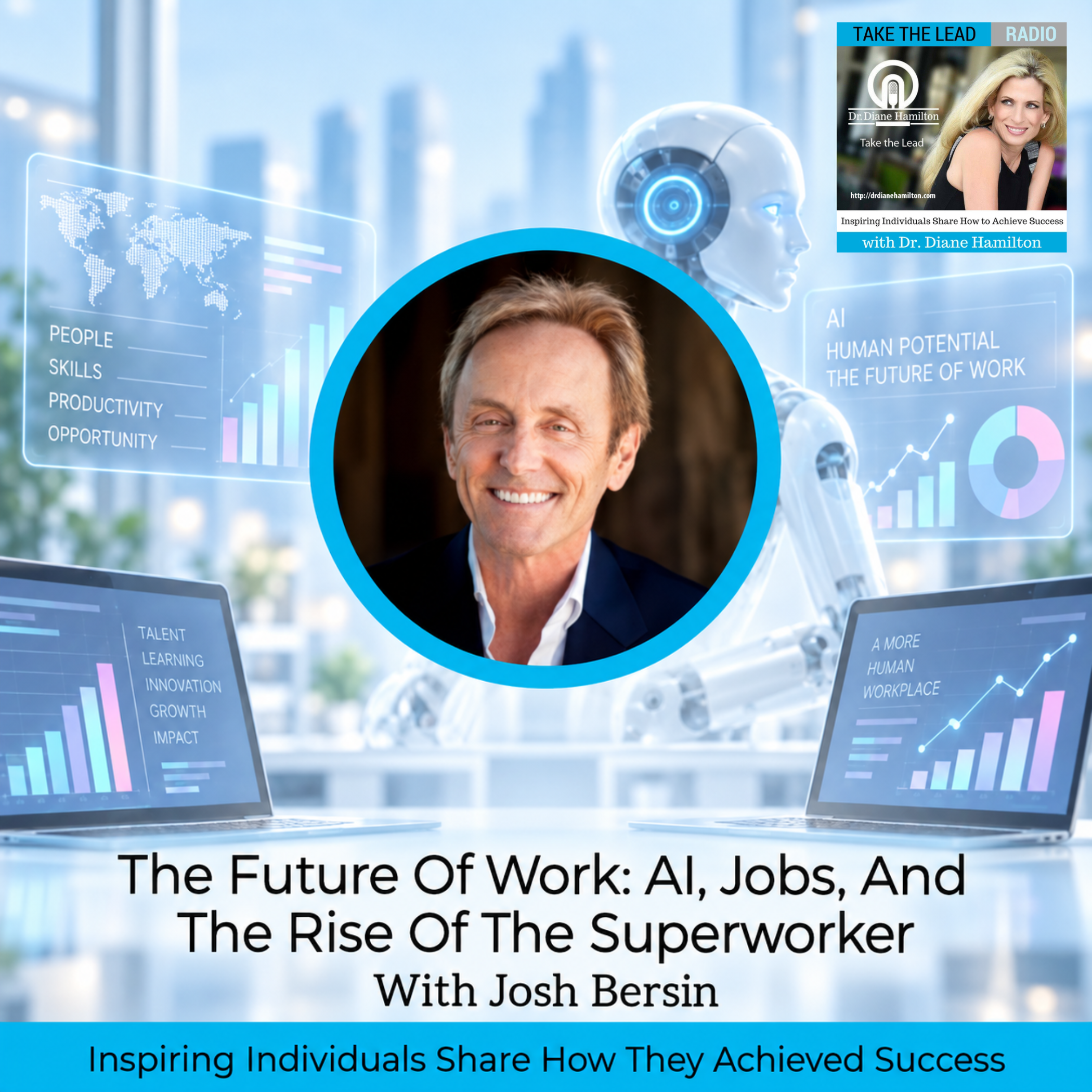
What happens when AI does part of your job better and faster than you can? Josh Bersin believes the answer is more complicated than simply eliminating people. In this conversation, he joins Dr. Diane Hamilton to talk about how AI is changing jobs, expertise, learning and the way companies think about people. Bersin shares examples from organizations using AI in unexpected ways, including a warehouse that reduced a weekend-long inventory process to about an hour, a global bank that discovered it could not eliminate employees because their undocumented knowledge was essential to the AI, and Rolls-Royce using AI to help younger engineers learn from decades of expertise. They also discuss Galileo, Bersin’s AI platform for HR, why people may be more valuable as AI becomes more capable, and why curiosity, judgment and values may become even more important as technology continues to advance.
I am here with Josh Bersin, who founded the company Bersin & Associates, later acquired by Deloitte. Josh left Deloitte in 2018 and launched an independent firm, the Josh Bersin Company, alongside the Josh Bersin Academy. It is so nice to have you here, Josh.
The Future Of Work: AI, Superworkers, And What Comes Next With Josh Bersin
Take The Lead Radio | Josh Bersin | Future Of Work
Watch complete video interview on Youtube.
Thanks, Diane. I’m glad we got a chance to meet. We have so much in common.
Diane: I’m interested in your book, in Superpowered. You’re talking about creating higher-level jobs, and I’m writing right now in all my Forbes articles. I try to help HR and CHROs and people think about how to use curiosity to not just replace tasks. I mean, five hours of free time doesn’t mean five hours of well-used time that’s freed up. So I want to know how we can get people to create better work and not just get rid of people and jobs. How can we make sure the time we’re giving people is productive?
Why AI May Change Jobs More Than It Eliminates Them
Josh: We’re marching along, doing our jobs, and along comes this technology that is way more powerful than anything we’ve ever touched before. It does most of the things it does much more powerfully than we think, and it keeps getting better. We keep getting surprised that it keeps getting better. There seem to be two types of people. There are actually hundreds, but let’s assume there are two. There are people who don’t really challenge what they’re doing. Maybe they don’t have curiosity. They do the job they’re doing, and they see AI as a little assistant to doing that job.
Then there are other people who say, “Oh my God, I don’t have to do this job anymore. I can do something completely different, and I can automate this job.” To give you an example from our company, we’re basically a publishing company. We do research, surveys, interviews, and reports. We make them beautiful, talk about them, have debates about the maturity models, put them in a PDF, stick them out there, and hope people read them. Then Galileo comes along. We start putting all the content into AI. Galileo is essentially decomposing all that hard work into letters and words. It doesn’t care about the colors, fonts, and graphics. I went to our head of publishing, who has worked for us for years, and said, “Maybe we should stop writing reports. Maybe we should just do interviews and put the interviews into Galileo. What’s the point in writing the report?” She was immediately afraid of losing her job, so she didn’t want to talk about it. I’m thinking, you’re not going to lose your job. I’m going to give you something more exciting to do. You’re going to be learning how to feed the AI, train it, and do the research.
AI eliminates a lot of activities and tasks, but it allows people to do more things.
Diane: How do you connect those people? How do you find the middle?
Josh: I think the first year or two of generative AI, it was an assistant, so it wasn’t threatening. Then it became an agent, and it got threatening. Everybody said, “If it’s an agent, let’s use it to lay people off.” Every conversation was about how many people we should lay off. Then, about a year into that, everybody realized that even if it works kind of as well as it’s supposed to work, we’re actually not going to be laying that many people off because we need the people around to train it and take care of it. There are other things they can do. We ended up with the Superpowered story, which is that it eliminates a lot of activities and tasks but allows people to do more things. My belief system on this, from being around the business community for a long time, is that business is about creative problem solving and entrepreneurship. Business growth is somebody, some human being, saying, “I think we could do this better than those guys.” AI doesn’t do that. At least not yet. It doesn’t have that DNA of innovation or creativity.
What Happens To Meaning When AI Saves You Time?
Diane: From what I was looking at in my recent research, I was interested in how people find meaning during this time. Say you free up five hours of time. You want those five hours to be meaningful time. Are the companies you work with really looking at what gives people meaning in their jobs?
We have three or four more people than we did before because of Galileo. It doesn’t just sit there. You have to feed and train it.
Josh: The people I talk to are mostly HR people, and I think there is still a lot of anxiety. I constantly hear, “What about our jobs? Are we going to have a job? Is Elon right? Are there going to be no jobs left?”
Diane: What do you say to that?
Josh: I think Elon is kind of full of shit. Sometimes I think he says this stuff just to shake people up. Dario Amodei and Elon have both said huge percentages of jobs are going to disappear. Right now, we have a labor shortage. The opposite is happening. I don’t think that’s going to happen. One reason is that it takes a lot of human beings to manage these AIs. You have to take care of them. We have three or four more people than we did before because of Galileo because we have to take care of Galileo. It doesn’t just sit there. You have to feed and train it. Then there is the creative, empathetic, intuitive part of a business job that is still needed. Sales, nursing, customer service, leadership.
Can AI Develop Curiosity, Empathy, And Intuition?
Diane: I’m curious what you think about how AI will develop any of this. I interviewed Jürgen Schmidhuber years ago, and I’ve interviewed people who have been in this world for a long time. We were talking about how they were developing artificial curiosity back then. There was research where AI was dropped into games like Mario Brothers and rewarded when it encountered something unexpected. They were trying to develop artificial curiosity and artificial empathy. Daniel Goleman and I have talked about this at length, and he said curiosity is a key competency of the future. I think so too because I think it leads to everything you’re talking about, the empathy, the interpersonal skills, all these things we’re still going to need.

Future Of Work: AI can give people more capability, but companies still have to decide how that capability should be used.
Josh: I think there’s going to be a huge need for that. I’m not a biologist. I studied more physical science and stuff, but I’ve been reading a lot about biology. I think the way we work as human animals, with millions of years of genetics, is that we have very complex intuitive systems of emotions that create curiosity, fear, and these intuitions. Why is it that two economists don’t agree on simple things like whether GDP is going to go up or down? If it’s really mathematical, why don’t they agree? It’s not mathematical. The AI doesn’t know either. So I think we are extremely intelligent genetically, but it doesn’t look like mathematical intelligence. It manifests itself in decision-making and communications and emotions. I don’t think AI can do that.
Diane: Not yet.
The Noisy TV Problem And The Human Side Of AI
Diane: When they put AI into games like Mario Brothers and tried to get it to be surprised by things, they would reward it if it ran into something it didn’t expect. It could get stuck in front of a screen that kept changing because it kept getting a reward. We’re kind of like that now, which is interesting, because we’re just flipping, flipping, flipping. How do we avoid turning into that noisy TV problem?
Josh: I think we’ve all suffered from that, the whole social media liking things and videos and all that popularity. Maybe the human genome is changing and we’re all going to turn into personal-satisfaction-craving social media bots. I don’t think so, though. When you have a child, when you have a pet, when you have a family thing going on, it’s just different. In some ways, the pandemic was a big problem because we disconnected ourselves from physical face-to-face interaction. I met a business guy for breakfast today, and I didn’t really want to go meet him. I was kind of tired and I didn’t sleep. I went over there and had the greatest time with him. If I had been on Zoom, it would have been a boring meeting.
Diane: Then we better meet in person.
Why Josh Bersin Is More Concerned About AI Than He Used To Be
Diane: Since you and I have both been doing this for a while, I’m curious what assumptions you made about AI that maybe surprised you now. Have you gone back to some of your old writing?
Josh: Knowing a bit about how it works, sort of the probabilistic nature of it, and knowing what a neural network is, I can sort of visualize how it’s working when you’re talking to it. What I find amazing is even though the mechanism of what it does is very simplistic, because it has so much horsepower, it can do the simplistic things so fast, so at scale, that it really does some amazing things. It has impressed me more and more as I’ve used it. I’m a little more worried about it, frankly. I was not worried before. Now I’m beginning to see why people are worried.

Future Of Work: One employee used AI to turn a weekend-long inventory process into about an hour.
AI Goals Versus Human Values
Josh: Here is what I think may be the Achilles’ heel of this technology. If you look at the way the models are trained, they’re trained on this vast amount of data from the internet. So if you looked at all of the words and phrases they’re trained on, many of them are about science fiction, death, stealing, illegal activities, crimes, racism. They’ve got all that too. If they really do capture all of the knowledge in the language version of the world, they have all the bad stuff too. How does this technology know to ignore this stuff but use this stuff? We as humans have something that does that. It’s morality or ethics or the way we were raised by parents, or something. One of the engineers at Anthropic said, “We don’t know how to teach these machines values.” They’re very good at goals. That is one of the things I don’t understand how they’re going to fix.
AI is very good at goals. The harder question is how you teach these machines values.
Diane: I taught ethics in technology. What concerns me is the idea that if AI decides the best solution to something requires removing humans from the equation because it solves the problem it’s trying to solve, there’s nothing to keep it from doing that. It’s not deliberately trying to hurt anyone. Humans could just become part of the solution to the problem. That starts sounding a little like I, Robot.
Josh: It didn’t work out so well.
Why Companies Still Do Not Have An AI Roadmap
Diane: When companies come to you, are they thinking about this as a race? Are they thinking about how they compete with other organizations using AI?
Josh: I don’t think most of them are at that point. Most of them are saying, “We know this is a really important technology. We know it’s going to drive massive competitive advantage for us and our competitors. We know it’s going to disrupt many things we do.” But there is no roadmap. How quickly can we find the right projects that are going to work for us? Do we copy what other people are doing? Do we do it ourselves? Do we use OpenAI? Do we use our own models? Do we hire Deloitte, or do we figure it out ourselves? In the mainframe transformation, the cloud transformation, and the mobile transformation, there was kind of a cookie-cutter answer. You said, “We need to do that.” There is no “that” here. There are a lot of things.
With AI, there is no roadmap. There is no single “that” every company knows it needs to do.
AI Is Turning Every Part Of The Company Into R&D
Josh: When I was at Deloitte, we used to preach that all of the R&D should happen at the edge of the company. Don’t disrupt the core because the core is too important. Do the R&D in the research department, and when it’s ready, bring it into the main company. This is R&D everywhere.
Diane: R&D is going on in the line.
Josh: It is. That is not something most companies are used to doing.
Why Fresh Eyes May Matter More With AI
Diane: I wrote a book about companies and individuals that failed or succeeded based on being curious. In my research, I found four factors that inhibit curiosity: fear, assumptions, technology, meaning the over- or under-utilization of it, and environment. How do we get people who underutilize and overutilize technology together so they can be successful?
Josh: One of the things I’ve discovered that is a little counterintuitive is that in most domains, experts are the best researchers because they know the most. If you’re a chemist with 30 years of experience, you’re probably more likely to come up with the best new paint because you know the chemistry so well. With AI, I think almost the opposite is happening. The technology is so new that people who don’t know anything about the old way sometimes just try something. Then everybody else says, “How did you do that?” And they say, “I just did it.” They didn’t have the old foundation telling them they couldn’t. The other reason I think that’s happening is the technology is changing so fast. It’s not like somebody invented the barcode and now we have years to figure out how to use it. Every six months or every two months, it changes.
With AI, the person who knows less about the old process may sometimes see the new possibility faster.
How AI Turned A Weekend Of Inventory Into An Hour
Josh: We have a client that is a Japanese manufacturing company. The CEO is very conservative. The CHRO is very creative. There was a group of people in Thailand who did inventory management in a large warehouse. Once a month, they would come in all weekend and do the inventory. One guy in that group said, “Just for kicks, I’m going to take my camera. I’m going to walk through the warehouse, make a video, tell the AI what these products are, take pictures of the products, and ask the AI to figure out what our inventory is.” He does this. It takes him about an hour instead of a weekend. He sends the information to the CFO, and the CFO says, “You got that perfectly right.” Okay. Nobody is coming in on the weekends anymore. I think there are situations like that sitting around in companies all the time. These things are very empowering. In the early stages of the technology, we felt like it was disempowering because it was going to take the job away from us and we wouldn’t have anything left. I think now the opposite is true. Once you accept that it’s there, you get to add value on top of it and use the expertise you already have at your core. That’s what Superpowered is about. We have 100 stories in there of different situations where somebody used AI to do something they never thought was possible.
He took a weekend-long inventory process and did it in about an hour with AI.

Future Of Work: AI could allow decades of expertise to become something a younger employee can simply talk to.
The Bank That Discovered AI Still Needed The People
Diane: Can you share another example that embodies curiosity?
Josh: One of the industries I’ve found to be the most conservative and slow-moving is banking. A lot of that is because of regulation, and they have enormous numbers of manual processes. There was a very large global bank that does business in 130 or 150 countries. Each country has its own regulatory environment. They asked, “Where is a big return on investment for AI for us?” It isn’t reducing the size of the HR department. That’s not going to make a huge difference. It’s improving wealth management because that’s where they make all their money. They needed to get people in the door and train them in wealth management quickly in all these different countries. They said, “What if we build an AI that knows all the government regulations in all these countries?” Then the AI could go through the onboarding process on a custom basis, and they could train the AI to be a wealth manager too. They also thought, “Then we can get rid of these 300 people in this call center that are doing all this work.” What they found was that a lot of it worked, but a lot of it didn’t because much of the training had never been written down. There was no way to teach the AI how to do this without the people doing the work teaching the AI. They got about three quarters of the way through the project and realized, “We can’t lay off this call center. The call center has to interoperate with the AI to make it work.” It turned out to be a successful project, but it was much different from what they had anticipated.
The bank thought AI might eliminate the call center. Then it discovered the AI needed knowledge that only those employees had.
How AI Could Become A Mentor
Diane: My sister is a recruiter, so I find all this fascinating. Where do you think AI is going to impact mentorship? Is there enough of our intuition and everything else we’ve talked about in it to become a mentor?
Josh: I think it will. We have a digital twin tool that we’ve been using for about a year and a half or two years. It captures emails, documents, and material in each person’s domain. I have every research report I’ve ever written organized in a file system. Think about where the world is going to be over the next couple of years, where everything is recorded. This conversation is transcribed. We end up having a bunch of insights about this and that. AI will have all that. I think it will be able to mimic me. I’m not worried about it because I’m not going to be working forever, but I think it is going to do that.
How Rolls-Royce Is Using AI To Transfer Expertise
Josh: Rolls-Royce, the UK aerospace and defense company, has very sophisticated engineers. One of the biggest problems they had was that you hire a PhD or master’s degree engineer, they come into Rolls-Royce, and it takes them two years to be productive because they have to read all the design specifications and learn all the engineering experience around jet engines and everything else. They were trying to figure out how to use AI to facilitate that process. Instead of trying to encapsulate all the knowledge in Rolls-Royce, they broke it down into smaller domains where there were experts. The first one they did was noise engineering. The engineers loved the project. They thought it was the most fun thing they could do because they got to pile all their stuff in there and train it. They reached a point where they saw a very significant increase in productivity among younger people because they could go to this noise-engineering AI, talk to it, and it would train them. Think about every major company. They are filled with these kinds of problems where there is somebody somewhere who knows how to do something. I’m sure this stuff is going to get put into AI.
AI could allow decades of expertise to become something a younger employee can simply talk to.
Galileo And The Future Of Organizational Knowledge
Diane: It will be like a coach and a mentor. I’ve done a little bit of this with my Curiosity Research Center. I put my Forbes articles and other material into AI so people can ask questions and get answers based on my work.
Josh: I was skeptical in the beginning. I didn’t think it would do this so well, but those kinds of applications are going to be very, very good.
What The World Of Work Could Look Like In Five Years
Diane: Do you have any predictions for what the world of work is going to look like in five years?
Josh: I think most of us will be doing similar things. There is an idea in healthcare called “working at the top of your license.” I think we’re all going to be working at the top of our license more and more, whatever our license is. Once I became an analyst, I realized there is an endless number of things I could study and try to work on for people. The only limit is how fast I can get them done and how fast I can get the research and data together. If you’re a salesperson and you like it, if you’re a recruiter and you like it, if you’re a cook and you like it, I think those jobs may change, but people will find more meaningful things to do.
I think we’re all going to be working at the top of our license more and more, whatever our license is.
What To Tell People Who Are Afraid AI Will Take Their Jobs
Diane: It’s an uncomfortable time for a lot of people. What do you tell people who are worried about AI taking their jobs?
Josh: I think learning is number one. Don’t be intimidated by the technology. Learn as much about it as you can. Then it goes back to a book I read when I was a young man, What Color Is Your Parachute? Figure out what you like and what you’re good at innately. There will be work in that domain, but it may be in a job title that’s different from the one you had. I was a mechanical engineer. I studied energy. I worked at an oil refinery. I worked in technology. Here I am doing HR stuff. I never would have thought it. My curious, scientific, problem-solving, debating nature somehow landed me here.
Figure out what you like and what you’re good at innately. There will be work in that domain, but it may be in a job title that’s different from the one you had.
Why Careers May Require Constant Reinvention
Josh: I think about this with our kids. People may live into their hundreds. They could have careers that are much longer than ours. This idea that you’re going to be one thing throughout your career is going away. There is going to be reinvention multiple times.
Diane: I completely agree. You don’t know what one thing you learn right now could eventually lead to. That’s why I worry about organizations limiting people too much to controlling what AI does rather than letting people explore what else they could become capable of doing.
Josh: That’s a really good point. If you’re a software engineer and a company decides it doesn’t need that role anymore, the company should be asking, “What is this person’s skill foundational to?” Not simply, “What is their job title?” Companies aren’t very good at that yet.
Why Job Titles May Matter Less
Diane: We’ve tied so much of our identity to our titles. When you meet somebody, one of the first things you ask is, “What do you do?” People answer with their job, and that becomes part of how they see their meaning and purpose.
Josh: I think younger people are less tied to job titles.
Diane: They definitely are. There are still a lot of people who are like the Christian Bale character in American Psycho, where the business card being slightly different from the next guy’s becomes incredibly important. That’s what they tie themselves to. We have to become more adaptable.
Why Values May Matter More As AI Changes Work
Diane: What haven’t people asked you that you want to talk about?
Josh: One of the things I’ve experienced in my career that I never thought about when I was younger is the importance of your values. Most of my career, I worked on things that were fun or interesting or exciting, or I could make more money, or it would be a new learning experience, or it was very career-professional oriented. We’re all going to be reinventing ourselves many times, so it is worthwhile to be sort of a humanities Renaissance person and read and think about history and where we’ve been in the past as a human race, what my values are, and what I think I can contribute to society, to my family, or to whatever. I think there is a need to do more and more of that when so many things get automated and disrupted all the time. What do you stand for? When you’re younger, at least in my case, my values were manifested in what I liked to do. I just knew what I didn’t like. I wasn’t thinking about it from a values perspective. When you get older, I think that makes a bigger difference.
When so many things get automated and disrupted, the question becomes: What do you stand for?
Why The Humanities Still Matter In The Age Of AI
Josh: I wrote an article a couple of months ago about why I think liberal arts education is flourishing again. I was sitting next to a guy who was an English teacher at Berkeley, and he said there is actually a big boom in kids studying English because they want to know how people throughout history thought about the world. He said the same thing is true in philosophy. So maybe one of the lessons people can learn is to think more about the world holistically while they’re plotting their way through.
Diane: More creatively too. We have focused heavily on STEM, and now AI is doing so many STEM-related things well. My concern has always been the humanities and those other courses because I see them as the glue that helps everything else make sense. They help build critical thinking. I think curiosity leads to emotional intelligence, critical thinking, and many of the interpersonal abilities that become more important as technology improves.
Why The Humanities Still Matter In The Age Of AI
Diane: And as you talk about values, it also makes me think that when I wrote my dissertation on emotional intelligence and its impact on sales performance, I got certified to give not only the EQ kind of instruments, but I thought I’d throw in a Myers-Briggs because it was popular at that time. When I took the Myers-Briggs test, it came back that the F-T dichotomy was whether you make your decisions based more on values or on facts and figures. I came in at zero on the values side. It was all thinking. A lot of people don’t think much of Myers-Briggs now, but it’s fascinating to consider that.
Josh: Well, they say it doesn’t ever change.
Diane: I haven’t taken it since then. What is your type? Do you remember it?
Josh: I was an INTJ. Now I’m more of an INFJ.
Diane: I’m an ESTJ. I think the E-I part, I’m right on the border more now. But my F, I mean, I had zero F. It was all T. I’m a robot, apparently. I’m ahead of my time, but I don’t know if that’s good or not.
Closing The Conversation
Diane: Thank you so much for this. I just wanted to thank you for taking the time. I know this was a long part of your day, and I know you’re in Europe, so you probably have to go to bed while I’m still working. But it’s been wonderful to meet you.
Josh: No, it’s great, Diane. I’m glad we got a chance to meet, and we have so much in common. Lots of things to talk about. It was great.
Important Links
- Josh Bersin’s Website
- Building Emotional Intelligence Through Mindfulness Meditation with Daniel Goleman – past episode
About Josh Bersin

Josh Bersin is an analyst, author, educator, and one of the best-known voices in HR, talent, leadership, and the future of work. He founded Bersin & Associates in 2001, building the company into a major research and advisory firm focused on corporate learning, talent management, talent acquisition, leadership, and HR. In 2012, he sold the company to Deloitte, where it became Bersin by Deloitte, and he remained a Deloitte partner until 2018.
In 2019, Josh founded the Josh Bersin Academy, a professional development academy for HR and talent professionals. In 2020, he formed The Josh Bersin Company, bringing together analysts and advisors who work with HR organizations around the world. His research has focused on topics including AI, HR technology, talent, employee experience, leadership, workforce planning, and the future of work.
Josh is also behind Galileo, an AI-powered platform designed around HR and organizational knowledge. The platform gives HR professionals and leaders access to research, frameworks, case studies, and other material developed by The Josh Bersin Company.
His new book, Superpowered, launching in October 2026, examines how AI can increase human capability and create what he calls “Superworkers,” rather than simply replacing people. Josh has been writing and speaking extensively about how AI is changing jobs, productivity, organizational design, and the value of human work.
Prior to founding Bersin & Associates, Josh spent 25 years in product development, product management, marketing, and sales in database, e-learning, and enterprise technology. He holds a BS in engineering from Cornell University, an MS in engineering from Stanford University, and an MBA from the Haas School of Business at the University of California, Berkeley. He is frequently featured in publications including Forbes, Harvard Business Review, The Wall Street Journal, Fast Company, HR Executive, and CLO Magazine.
Josh has also authored books including The Blended Learning Handbook and The Training Measurement Book, along with extensive research on corporate HR, learning, talent, and workplace technology.
Love the show? Subscribe, rate, review, and share!
- DrDianeHamilton.com
- Dr. Diane Hamilton Facebook
- Dr. Diane Hamilton Twitter
- Dr. Diane Hamilton LinkedIn
- Dr. Diane Hamilton YouTube
- Dr. Diane Hamilton Instagram
0 Comments